Thinking about hosting an event?
Or maybe you’ve already hosted one—and walked away thinking, that was great… but how are people actually making money from this?
Because from the outside, events can look like a lot of energy for not a lot of return. They take time, coordination, and a level of visibility that can feel intimidating if you’re still building momentum.
So they get pushed off.
Something you’ll do later, when your audience is bigger. When your business feels more established. When everything is more “ready.”
But that’s not how events actually work.
Events are not something you earn the right to do.
They are one of the things that help you grow faster—when you approach them strategically.
And more importantly, they are one of the most misunderstood growth levers in the personal brand space.
Beofre you dive in below…
Here’s the podcast episode of The Power Table Podcast on this topic (Spotify or Apple) if you’d prefer to listen.

Why Events Change the Game (When They’re Done Right)
Most people think of events as an extension of their content.
A place to teach, share ideas, or bring people together.
But that’s not what makes them powerful.
What makes events different is the level of proximity they create.
When someone is consuming your content online, they’re engaging with a version of you that’s filtered through a screen. A caption, a clip, a curated moment.
But when someone is in a room with you—even virtually—the experience shifts.
They’re not just hearing what you say. They’re seeing how you think. How you lead. How you respond in real time.
And that creates something content alone can’t replicate.
Trust—faster than anything else in your business.
Instead of someone following you for months before deciding to work with you, an event can move them from “I just found you” to “I trust you and I’m ready for the next step” in a matter of hours.
That compression of time is what makes events so powerful.
They don’t just make you visible.
They position you as the person leading the room.
Where Most People Go Wrong
When founders decide to host an event, they often start in the same place:
“What should I teach?”
It feels like the logical first step. You want to deliver value. You want the content to be strong.
But that question, on its own, leads to events that feel disconnected—because it’s focused on you, not the outcome.
The better question is:
What is this event designed to do?
Because every decision that follows—your messaging, your structure, your pricing, your experience—should be shaped by that answer.
Some events are designed to deepen relationships. Others are designed to convert. Others exist to expand visibility and authority.
None of these are better than the others.
But not choosing one is where things start to fall apart.
Without a clear purpose, your event becomes a collection of ideas instead of a cohesive experience. And when that happens, your audience feels it.
Clarity is what creates confidence—for you and for the people attending.
The Shift That Makes an Event Actually Work
There’s another shift that has to happen if you want your event to succeed.
You have to stop building it around what you want to say.
And start building it around where your audience is stuck.
This is where a lot of events miss the mark.
They’re filled with good ideas, valuable insights, and strong teaching—but they try to cover too much, or they’re not anchored in a clear transformation.
Your audience is showing up with a gap.
They are at point A, and they want to get to point B.
Your job is not to give them everything you know.
It’s to move them forward—clearly, quickly, and in a way that feels achievable.
When that gap is defined, everything becomes easier.
Your content becomes more focused. Your messaging becomes more compelling. And your audience becomes more engaged, because they understand exactly what they’re there to gain.
A few in-person event ideas you might not have thought of:
- Book or podcast launch parties
- CEO days / in person community co-working
- Group VIP days
- Retreats
- In person workshops and trainings
- Masterminds (1-4 days)
- Boutique conferences
- Content days
- Networking meetups
A few online event ideas:
- Summits
- Challenges
- Live panels or live podcasts
- Co-working calls
- CEO reset days
- Virtual retreats
- Annual or quarterly planning workshops
- “Switch to X” software workshops
- “Done in a day” events
Why Bigger Isn’t Always Better
There’s also a belief that the success of an event is tied to its size.
More people. Bigger room. Higher production.
But in reality, larger events often create more complexity without necessarily increasing results.
Smaller, more intentional events can create deeper connection, stronger engagement, and more meaningful outcomes—especially when they are designed with clarity and purpose.
Because what actually drives results is not the number of people in the room.
It’s the quality of the experience inside it.
How Events Actually Generate Revenue
One of the biggest misconceptions around events is that revenue comes from ticket sales alone.
And while ticket sales can absolutely be a piece of the equation, they are rarely the most significant one.
The real value of an event is not just what happens during it.
It’s what it leads to.
An event creates a concentrated moment of trust, attention, and engagement. And when that moment is designed intentionally, it naturally opens the door to deeper work.
That might look like a program, a mastermind, a service, or another experience that continues the relationship.
It can also include additional layers within the event itself—upgraded experiences, brand partnerships, or extended offers that enhance both the revenue and the overall experience.
But the key is that monetization is not an afterthought.
It is something that is designed into the structure from the beginning.
The Part That Makes or Breaks Everything
There is one factor that determines whether your event feels seamless—or overwhelming.
And it’s not your content.
It’s how organized your back end is.
Because what often happens behind the scenes looks like this:
Your ideas are in one place.
Your logistics are in another.
Your speaker details are buried in emails.
Your timeline keeps shifting.
And instead of executing the event, you’re trying to manage all the moving pieces at once.
This is where having a centralized system changes everything.
How I Organize My Events (and Why It Matters)
As my events grew, I realized I couldn’t rely on scattered tools and documents anymore.
I needed a way to bring everything together—so I could actually lead the experience, not just manage it.
One thing that’s helped me streamline this as my events have grown is using Adobe Acrobat to create centralized event hubs. You can try PDF Spaces inside of Adobe Acrobat Studio for free for 7 days here.
Inside a PDF Space in Acrobat, I map out:
- Event goals
- Session flow
- Monetization plan
- Sponsor deliverables
So everything lives in organized folders instead of being scattered across tools and can be shared with the right people to collaborate on at the right time. It’s not the strategy—but it supports the strategy in a really practical way.
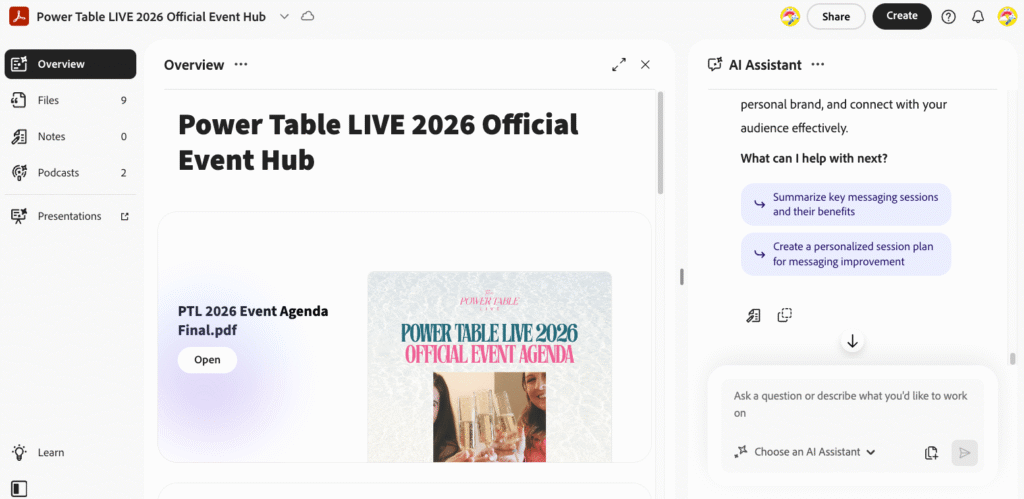
This is the event hub we built for our Power Table LIVE attendees!
One of the reasons I love using PDF Spaces for this is how easy it is to share. You can send your entire event hub to attendees in a single link, and they don’t need an Adobe Acrobat subscription to access it. It removes the friction of “where do I find everything?” and gives them one clear, organized place to engage with your event materials.
It also enhances the attendee experience in a really powerful way. Inside the PDF Space, they can quickly understand materials through built-in summaries, or even use an AI assistant to ask questions, explore content, and get more out of what you’ve created. So instead of just handing them information, you’re giving them a way to actually interact with it.
Full disclosure: We’re Adobe Acrobat Ambassador, which means we partner with Adobe and may receive compensation for sharing their tools. We have included it here because it’s part of our actual Power Table event workflow.
Creating a Better Experience for Your Audience
What makes this even more powerful is how it extends beyond your internal planning.
You can create a centralized hub for your attendees as well—housing everything they need to engage with your event.
Agendas, resources, speaker materials, logistics—all accessible in one place.
There’s no confusion. No searching. No friction.
And with built-in AI tools, attendees can actually interact with the content—asking questions, exploring materials, and getting more value from what you’ve created (oh and your attendees don’t need an Adobe acocunt to use it).
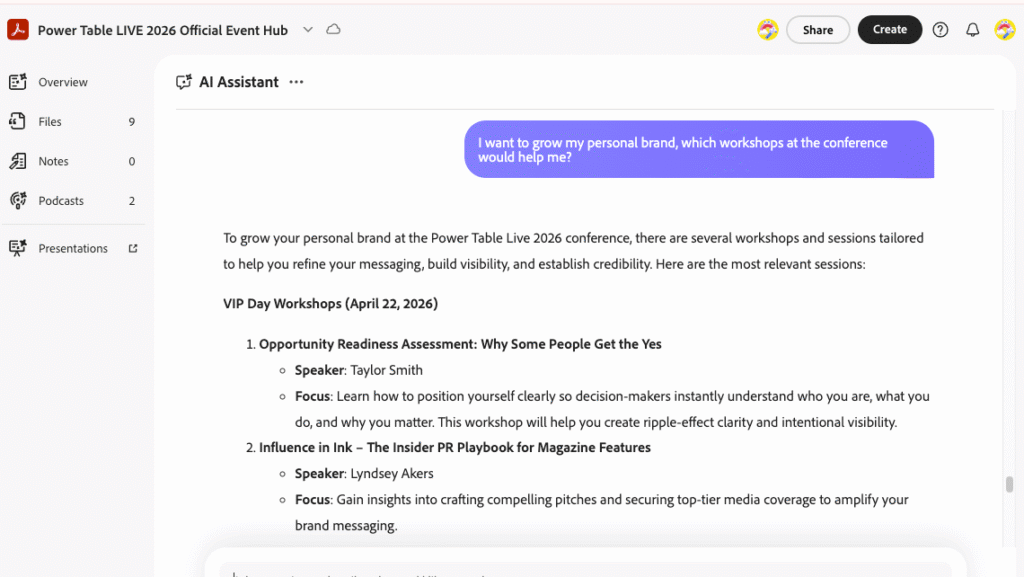
It turns your event from something they attend into something they experience. You can see above how event attendees can ask questions inside the PDF Space and AII Assistant answers their questions with fully personalized answers based on the files we uploaded (such as the event agenda).
You can try PDF Spaces inside of Adobe Acrobat Studio for free for 7 days here.
Final Thought
If you’re thinking about hosting an event, start here:
What do I want this to lead to?
Because that answer will shape everything that follows.
And when you build your event around that clarity, it doesn’t just fill a room.
It moves people.
And that’s where the real impact—and the real growth—begins.